Feb 12, 2026
Client Profile
A Web3-native remittance provider focused on high-frequency retail payouts, starting with the USD–INR corridor.
The company processes nine-figure annual volumes and competes on speed, reliability, and pricing transparency. As demand accelerated, the team prepared to scale aggressively and expand into GBP and EUR corridors, without compromising instant payout guarantees.
The Constraint Was Settlement Behavior
The business had a strong product–market fit. Demand was not the limiting factor.
What constrained scale was settlement latency — the structural delay between payout execution and underlying settlement across banks, on/off-ramps, and FX rails.
Before Zynk:
Weekday settlements took ~2 days; weekends extended to ~4 days
Payouts were gated by bank cut-offs and partner SLAs
Instant payouts required capital to be pre-positioned ahead of settlement
Treasury teams actively managed liquidity buffers, FX exposure, and timing risk
As volumes grew, payout finality remained tightly coupled to settlement finality. Scaling meant financing that delay with increasing amounts of capital.
The team faced a clear choice:
Scale the balance sheet to match settlement lag and remove settlement lag from the system.
Why Existing Models Broke Down
Traditional approaches attempted to work around settlement latency:
Banks and local rails settled slowly and corridor-by-corridor
Pre-funding scaled linearly with volume
Working capital facilities added fixed costs to variable flows
OTC execution and on/off-ramps introduced pricing opacity and operational drag
Despite their differences, these models shared one assumption:
Payouts must wait for settlement — or be financed until it completes.
What the client needed was not a new rail, partner, or liquidity source.
They needed instant settlement as a platform capability.
Zynk: An Instant Settlement Layer
Zynk is an embedded settlement layer that guarantees instant payout finality at the transaction level — independent of when underlying rails settle.
It integrates behind existing banks, PSPs, and on/off-ramps, and changes how settlement behaves without requiring changes to customer-facing flows.
Liquidity is embedded as an internal mechanism — not exposed as a product. It exists solely to uphold Zynk’s instant settlement guarantees while underlying systems settle asynchronously.
As a Result, Zynk:
Decouples payouts from bank and rail settlement timelines
Removes the need to pre-fund corridors
Abstracts settlement complexity away from treasury and operations
Zynk can sit on your existing rails with embedded liquidity.
It replaces settlement latency as a constraint.
Deployment
Phase 1 – Validation
USDT → INR flow
Integrated via Zynk’s settlement layer
Live testing completed in ~1 week
Phase 2 – Production Rollout
USD on-ramp → INR off-ramp coverage
One-time integration with Zynk, compatible with supported on-ramp partners
Instant settlement behavior extended across live production payouts
Full rollout completed in ~2 weeks
From the Client’s Perspective
No pre-funding requirements
No OTC execution
No changes to the customer payout experience
Only settlement behavior changed.
Results
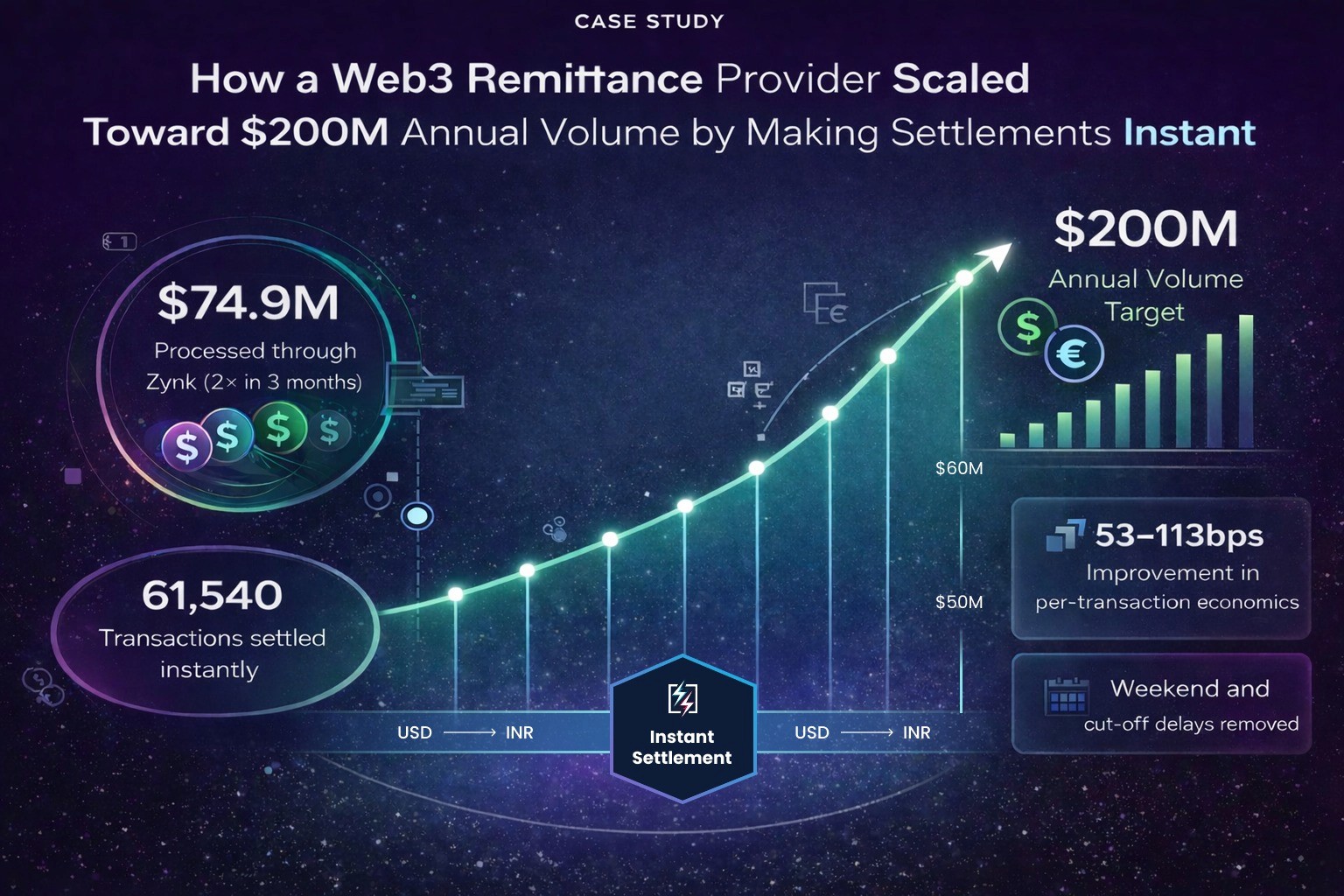
$74.9M
Processed through Zynk (2× in 3 months)
61,540
Transactions settled instantly
53–113 bps
Improvement in per-transaction economics
Fully Abstracted
Weekend and cut-off delays removed
What Changed at Scale
The client’s target was ~$200M in annual volume.
Under traditional models, maintaining instant payouts at that scale would require millions of dollars locked purely to bridge settlement delays.
With Zynk, settlement no longer required capital to be held ahead of demand. Growth stopped being limited by balance-sheet mechanics and treasury coordination.
Settlement became infrastructure — not something the business had to finance.
Why This Matters
This case was not about optimizing liquidity or switching rails.
It demonstrated that instant settlement can exist as a platform primitive — even when underlying financial systems remain slow.
With Zynk, the client can now scale volume, expand corridors, and operate continuously without restructuring its balance sheet around settlement timing.
From the CEO
“Zynk didn’t change how we move money — it changed what constrained us.
Settlement stopped being a balance-sheet problem and became infrastructure.”